

4. Constructing Point Defects#
4.1. Overview#
Questions
Why are defects important?
How can I simulate point defects?
Objectives
Create supercells for defect calculations
Introduce a point defect (substitutional impurity or vacancy)
Key Points
Supercells are created with
make_supercellusing a supercell expansion matrixPoint defects are introduced by modifying symbols (substitution), deleting atoms (vacancy) or inserting atoms (intersitital)
Defect supercells typically need 100–200+ atoms
4.2. Lecture Slides#
The slides for this tutorial are embedded below. 📥 Download slides (.pptx) | Open in full screen
4.3. Creating Supercells#
Supercells are important for defect calculations, where a defect should not interact with its periodic images.
A rule of thumb is to use a supercell where the defect–defect image distance exceeds ~10 Å.
4.3.1. Example: Diamond supercell#
Start with the unit cell for diamond (a = 3.57 Å)
from ase.build import bulk

diamond_primitive = bulk('C',   'diamond',  a=3.57)

print(f"Primitive cell: {len(diamond_primitive)} atoms")
print(f"Primitive cell dimensions: {diamond_primitive.cell.lengths()} Å")
Primitive cell: 2 atoms
Primitive cell dimensions: [2.52437121 2.52437121 2.52437121] Å
This shows we need at least a 4×4×4 supercell for the defect-defect image distance to be more than ~10 Å. First, we use numpy to create a supercell expansion matrix which specifies how we want our unit cell to be expanded.
import numpy as np

sc_matrix = np.diag([4, 4, 4])
Use the make_supercell function in ase to create a supercell. We provide it with the supercell expansion matrix and the primitive unit cell:
from ase.build import make_supercell

diamond_super = make_supercell(diamond_primitive, sc_matrix)

print(f"4×4×4 supercell: {len(diamond_super)} atoms")
print(f"Supercell dimensions: {diamond_super.cell.lengths()} Å")
4×4×4 supercell: 128 atoms
Supercell dimensions: [10.09748484 10.09748484 10.09748484] Å
4.4. Creating Point Defects#
Point defects are central to quantum optics: the NV centre in diamond, the boron vacancy in hBN, and rare-earth substitutionals in wide-gap semiconductors are all point defects that emit single photons.
4.4.1. Example: The NV centre in diamond#
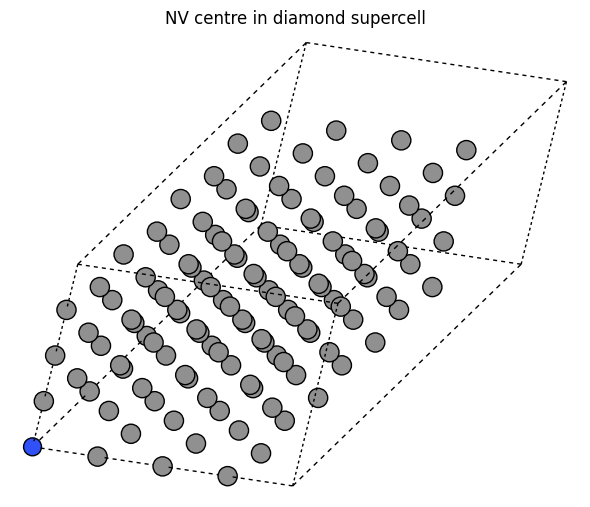
The nitrogen-vacancy (NV) centre consists of a substitutional nitrogen atom (N_C) adjacent to a carbon vacancy (V_C). It is the best-studied solid-state qubit and single-photon emitter.
Build a diamond supercell
sc_matrix = np.diag([4, 4, 4])
nv_cell = make_supercell(diamond_primitive, sc_matrix)
print(f"Pristine supercell: {len(nv_cell)} atoms of C")
Pristine supercell: 128 atoms of C
Find two nearest neighbour C atoms using the
get_distancesfunction
from ase.geometry import get_distances
_, dist_matrix = get_distances(nv_cell.positions, nv_cell.positions,
                                cell=nv_cell.cell, pbc=True)
np.fill_diagonal(dist_matrix, np.inf)   # the diagonal is the distance between an atom and itself; fill this with infinity.
nearest_idx = np.argmin(dist_matrix[0])   # now use numpy's argmin function to find the nearest neighbour to atom 0
print(f"Nearest neighbour to atom 0: atom {nearest_idx}, "
      f"distance = {dist_matrix[0, nearest_idx]:.3f} Å")
Nearest neighbour to atom 0: atom 1, distance = 1.546 Å
Substitute atom 0 with nitrogen using the
setterandgettermethods from Lab 2
symbols = list(nv_cell.get_chemical_symbols())
symbols[0] = 'N'
nv_cell.set_chemical_symbols(symbols)
print(f"After N substitution: {nv_cell.get_chemical_formula()}")
After N substitution: C127N
Create a vacany at the nearest C site
del nv_cell[nearest_idx]
print(f"After vacancy creation: {nv_cell.get_chemical_formula()}")
print(f"NV supercell: {len(nv_cell)} atoms")
After vacancy creation: C126N
NV supercell: 127 atoms
Visualise the result
# Visualise the NV centre region
fig, ax = plt.subplots(figsize=(6, 6))
plot_atoms(nv_cell, ax, rotation=('10x,10y,0z'), radii=0.4)
ax.set_title('NV centre in diamond supercell')
ax.axis('off')
plt.tight_layout()
plt.show()
4.4.2. Exercise: Boron vacancy in hBN#
A) Build a 4×4×1 supercell of hexagonal boron nitride (hBN). hBN is a 2D material, so use pbc=[True, True, False] and add 20 Å of vacuum in the z-direction. Print the supercell dimensions and number of atoms.
B) The boron vacancy (V_B) in hBN is an emerging single-photon emitter. Starting from your hBN supercell, create a V_B defect by deleting one boron atom.